
William Hill Ireland: licence and payment evidence
The money trail is the most important unresolved part of this assessment. A current Revenue register entry connects the William Hill trading name or domain with William Hill Malta plc under remote bookmaker reference 1016824. That is useful primary evidence about the licensed entity, but it does not establish which deposit methods an Irish customer will see, how quickly a withdrawal will arrive, or which documents may be requested before funds are released.
The resulting signal is amber. The official register supports the named business relationship, while the supplied packet contains no completed deposit or withdrawal test, operator payment terms, fee schedule, identity-verification policy or independently established complaint outcome. The licence evidence answers an important question; it does not answer every money-handling question.

Payment audit: what is established and what remains open
No payment method can be confirmed from the accepted records. There is no supported list of cards, bank services, electronic wallets, minimum deposits, withdrawal limits, processing times or operator fees. Availability should therefore be checked inside the authenticated cashier before any deposit, rather than assumed from another market or an undated promotional description.
The same limitation applies to withdrawals. No test account was funded, no withdrawal was requested, and no bank receipt was supplied. There is consequently no evidence-led basis for describing withdrawals as instant, fast, delayed or refused. A displayed estimate would also be different from observed settlement: internal approval, identity review, weekends and the receiving bank can affect the final arrival time.
| Money question | Evidence position | Practical check |
|---|---|---|
| Which deposit methods are available? | Not established | Record the methods and limits shown after signing in. |
| How long does a withdrawal take? | Not tested | Save the request time, approval notice and bank-credit time. |
| Are customer fees charged? | Not established | Read the cashier disclosure before confirming the transaction. |
| Can a payment trigger verification? | Unknown in the packet | Keep account and payment-holder details consistent. |
| Was a successful bank receipt observed? | No | Do not treat an on-screen status as proof of settlement. |
For a repeatable way to preserve transaction evidence, use the payment-check procedure. A useful record includes the amount, method, date, displayed status and redacted proof of arrival. Full card numbers, passwords, one-time codes and unredacted identity documents should never be included in a complaint bundle.
Exact domain, entity and Revenue reference
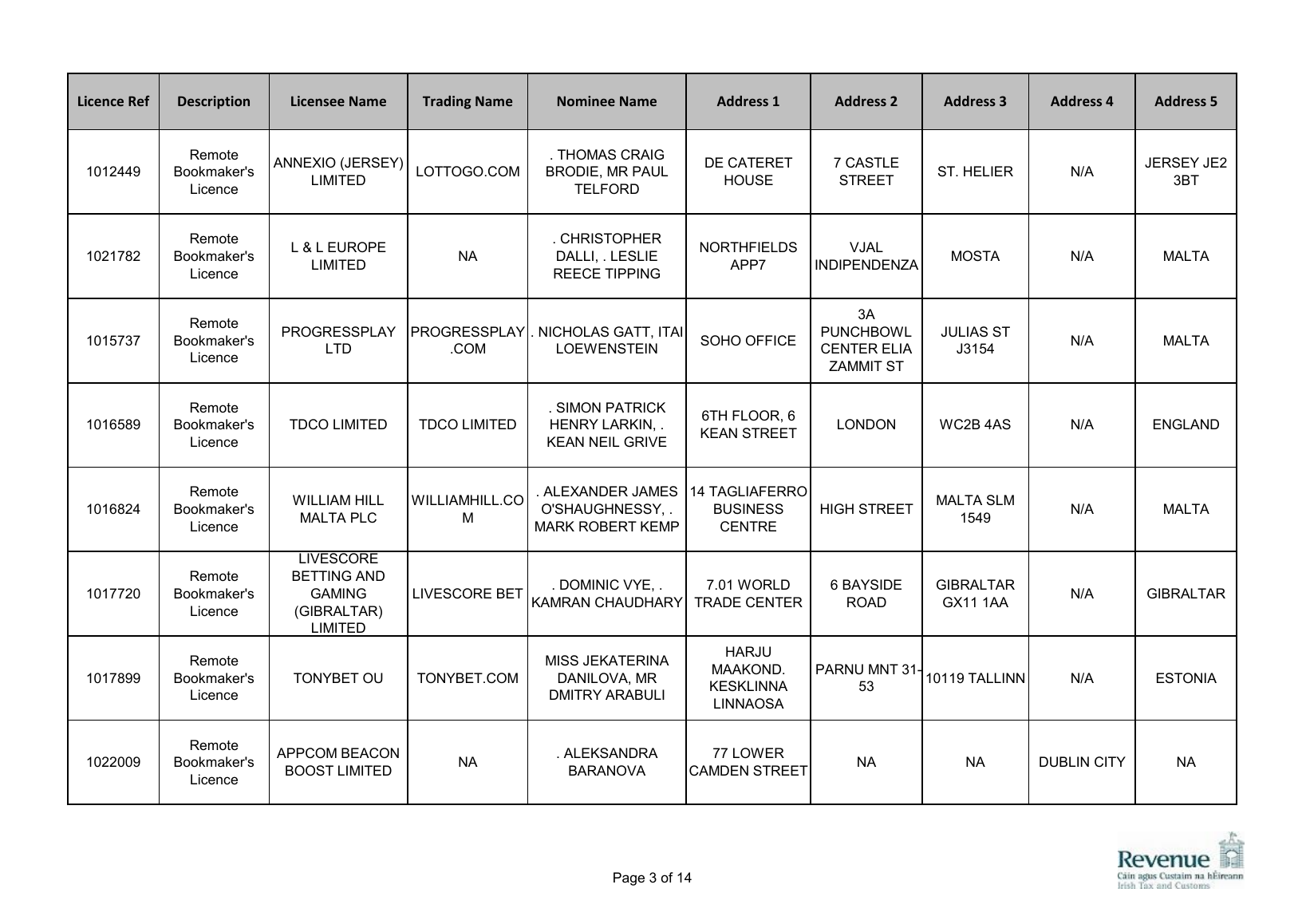
The central primary record is Revenue’s register dated 30 June 2026. It lists William Hill Malta plc with the relevant trading name or domain under remote bookmaker reference 1016824. The record was checked on 21 August 2026. This provides a dated connection among the operator name, commercial identity and Irish remote-bookmaker reference.
The domain supplied for verification is williamhill.com. That spelling matters. A familiar colour scheme, search advertisement, mobile shortcut or copied identification image does not establish that a customer is using the recorded domain. Before entering credentials or payment details, inspect the complete address, including the ending, spelling and any added words.
The Revenue register entry is the strongest accepted evidence in the packet. It supports the register claim precisely; it does not prove the terms of every product, the result of a customer dispute, or the performance of a particular withdrawal.
| Identity field | Supported value | Confidence boundary |
|---|---|---|
| Verified domain | williamhill.com | Check the complete address on every visit. |
| Named entity | William Hill Malta plc | Supported by the dated Revenue register. |
| Trading identity | William Hill | Connected in the same primary record. |
| Remote bookmaker reference | 1016824 | Register dated 30 June 2026. |
| Licence expiry | Not supplied | No expiry date should be inferred. |
A step-by-step explanation of matching a domain to an official record is available in licence checks.
Is it legitimate, or is it a scam?
The accepted primary evidence does not support calling the exact recorded operation a scam. Revenue’s dated register identifies the operator and reference, which is materially stronger than a self-written badge or promotional assertion. Equally, a register entry should not be stretched into a guarantee that every transaction will be problem-free or that every website using the name is genuine.
The amber signal reflects that distinction. There is a positive official identity match, but open evidence remains around payments, withdrawals, identity checks and case handling. Amber is not an allegation of wrongdoing. It means the evidence is sufficient for a defined licence finding but incomplete for a broad endorsement of operational performance.
A scam concern should be separated into two questions. First, does the official record match the entity and domain? Here, the supplied Revenue record provides that connection. Second, is the customer actually on that domain and dealing through its genuine account area? That must be checked at the point of use. A cloned address can imitate a legitimate commercial identity without inheriting its register status.
Warnings deserve evidence too. Unsolicited requests to send money to an individual, disclose a one-time code, install remote-access software or move a complaint to an unrelated messaging account are reasons to stop. They do not, by themselves, prove who operated the contact. Preserve the address, message headers and transaction information, then consult the scam-warning checklist.
Is the service legal for customers in Ireland?
The dated Revenue entry supports the conclusion that the named entity was listed as a licensed remote bookmaker under reference 1016824 in the register dated 30 June 2026. That is the precise legal-status finding available from the packet. It should not be rewritten as a timeless licence, a casino-product approval, an expiry confirmation or personal legal advice.
Ireland’s regulatory arrangements are also in transition. The GRAI operator portal states that the Gambling Regulatory Authority of Ireland began accepting remote and in-person betting applications in February 2026 and notes the transition from Revenue. The Gambling Regulation Act 2024 establishes the statutory framework and the GRAI.
| Legal-status question | Supported answer | Limitation |
|---|---|---|
| Is the entity in the supplied Revenue register? | Yes | The finding is tied to the register dated 30 June 2026. |
| Is reference 1016824 supported? | Yes | It is a remote bookmaker reference in the accepted record. |
| Is an expiry date known? | No | None was supplied. |
| Does the record approve every offered product? | Not established | Product-by-product permissions were not supplied. |
| Is the regulatory system changing? | Yes | GRAI reported an application process and Revenue transition. |
Anyone relying on legal status should repeat the register check close to the date of use. Registers and transition arrangements can change. The factual conclusion here is dated, narrow and attached to the precise entity-domain match.
Identity checks and the unsupported KYC gap
No accepted source describes the operator’s current know-your-customer procedure for Irish accounts. The packet does not establish which documents are accepted, when a check begins, how long review takes, whether proof of address is always required, or what happens when details do not match. Those points must remain unknown rather than being filled with practices associated with other bookmakers.
A mismatch can arise when the account name, date of birth, address or payment-holder name is inconsistent. This dossier does not claim that any particular mismatch will cause a delay. It does, however, make sense to review entered details for accuracy before depositing and to use a payment instrument that the customer is authorised to use.
If documents are requested, the safest evidentiary approach is to record what was requested, when it was submitted and what response followed. Send sensitive material only through a verified secure account channel. Do not publish identity documents in a public review or send them to an address obtained solely from an unsolicited message.
The absence of a supplied KYC policy also limits the payment verdict. A withdrawal result cannot be evaluated fairly without knowing whether a documented identity request was outstanding, completed or disputed. That is why a screenshot saying “pending” would not, on its own, establish either normal processing or misconduct.
Withdrawal evidence and bank-level proof
A withdrawal audit needs more than an account-screen status. The strongest practical sequence is the request confirmation, any verification correspondence, the approval or completion notice, and redacted bank or payment-account evidence showing when the money arrived. None of those items was supplied for this assessment.
| Withdrawal stage | Useful record | What it can establish |
|---|---|---|
| Request submitted | Timestamp and amount | When the customer initiated the request. |
| Verification requested | Dated message and requested category | That an additional check was communicated. |
| Marked approved | Account status or notice | The operator’s stated approval time, not bank receipt. |
| Funds received | Redacted bank or wallet entry | Actual settlement date and amount. |
| Complaint raised | Case number and dated correspondence | The escalation history and response trail. |
A pending status is not proof of a completed payment. Conversely, a user statement about delay is not enough to establish the cause. The missing bank evidence means there is no defensible average withdrawal time and no verified failed-withdrawal finding.
Before making a first substantial deposit, a customer may choose a smaller amount consistent with personal limits and check all displayed withdrawal conditions. That is a risk-control suggestion, not a claim that a particular amount will be processed faster. Gambling should never be used as a way to solve financial pressure; responsible-gambling support is available for limit and support information.
Complaints: build a dated, redacted record
A complaint should begin with a concise chronology. Include the account identifier that support requests, transaction amount, method, request date, displayed status and the exact outcome sought. Attach redacted evidence and retain the original files privately. Avoid sending passwords, complete card details or security codes.
The supplied packet does not identify the operator’s current internal complaint address, response deadline, alternative dispute body or final-response wording. Those details cannot be invented. Use only contact information reached through the verified domain or authenticated account area, and save evidence showing where the contact route was found.
If the issue concerns identity, separate the dates of request, submission and response. If it concerns a withdrawal, distinguish operator approval from receipt by the bank. If it concerns access to an account, state whether funds remain involved without speculating about the cause. Clear separation makes the record easier to assess.
The complaints guide explains how to organise a case and preserve a reference number. Regulatory escalation depends on the issue, date and applicable transition arrangements, so a complainant should check the current official route rather than assume that a historical process still applies. No adverse complaint finding against this entity is established by the accepted sources.
Clone checks before signing in or paying
A clone can reproduce colours, wording and identification images while using a different address. Begin with the full domain: williamhill.com. Look for extra words, substituted characters, unexpected country endings or a longer address in which the familiar name is only a subdomain. Do not rely on the page title alone.
Open the service from a deliberately verified route rather than a link in an unsolicited message. Password-manager behaviour can provide a warning when credentials were saved for a different address, but it is not official proof. A secure-connection symbol only indicates an encrypted connection to the displayed domain; it does not confirm that the domain belongs to the recorded operator.
| Check | Expected evidence | Stop condition |
|---|---|---|
| Full address | Exact supplied domain | Added words, misspelling or different ending. |
| Entity claim | William Hill Malta plc | Unexplained different company receiving funds. |
| Payment request | Normal authenticated cashier context | Transfer to an individual or unrelated business. |
| Security request | No demand for passwords or one-time codes | Request to disclose credentials or install remote access. |
| Licence claim | Match to reference 1016824 | Badge or number that cannot be matched. |
If a suspicious copy is encountered, do not sign in to test it. Preserve the address and non-sensitive context, then use the contact route for a factual correction or clone report. The presence of a clone would not change the identity of the legitimate registered entity, but it would make exact-domain checking essential.
User reports: context, not a finding
The supplied App Store capture displays dated user ratings and review statements concerning the mobile application. Those statements are user context only. They have not been independently verified, and they cannot establish a general payment speed, a systemic fault, the cause of an account issue or a regulatory breach.
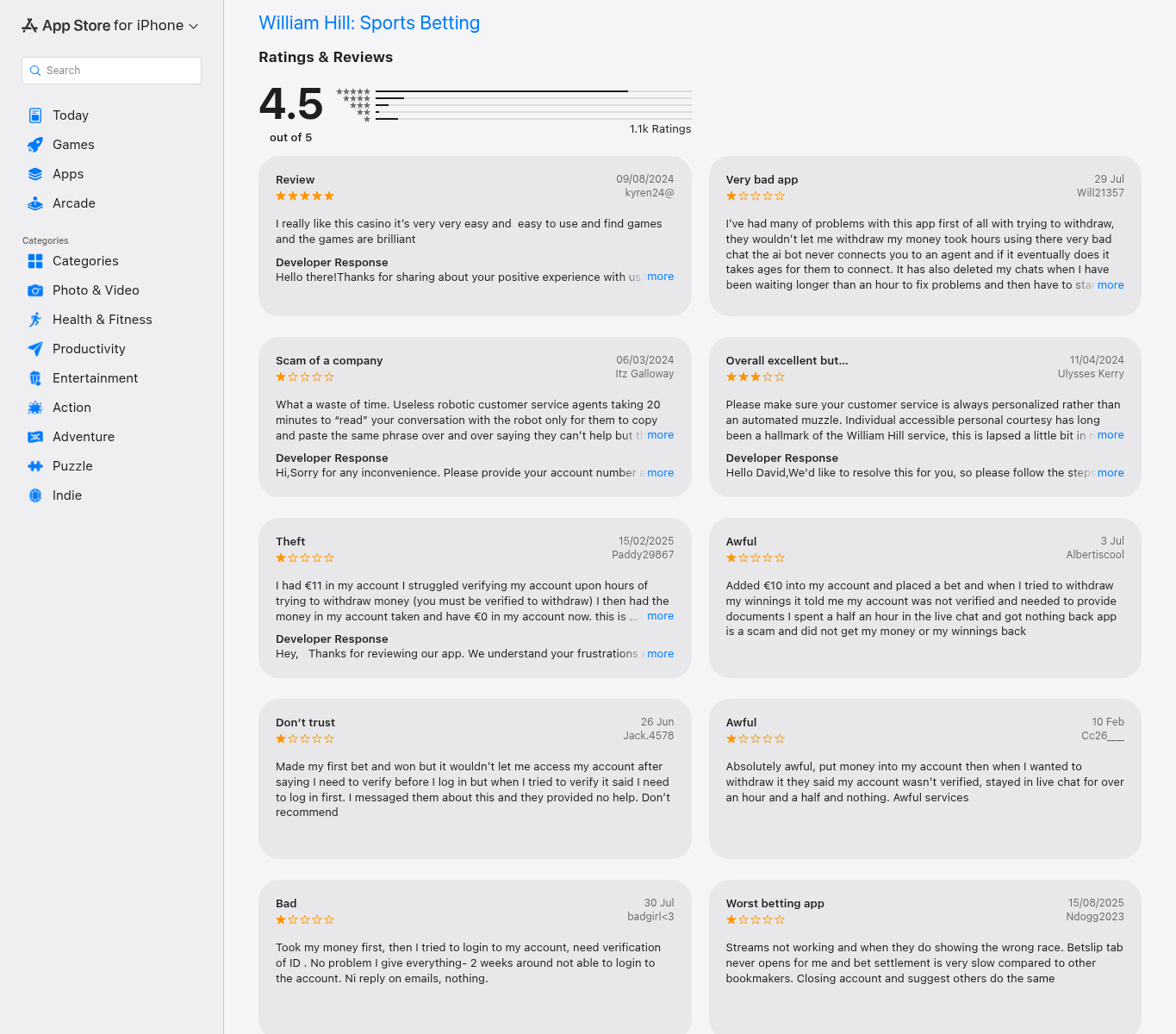
User reports can still identify questions worth testing. A dated report may suggest checking login access, application stability, verification communication or transaction records. It should not be converted into a confirmed event unless supporting records establish what happened and connect it to the precise account, domain and time period.
The evidence hierarchy is therefore deliberate: the Revenue register supports the entity and reference; official legal and regulatory records describe the framework; user statements describe individual perceptions. None of these source types substitutes for bank-level proof of a withdrawal or an operator case file.
Evidence chronology, method and open risks
The core record is dated 30 June 2026 and was checked on 21 August 2026. On the same check date, the GRAI portal, statutory framework and App Store context were recorded. No later licence update, payment test, complaint decision or identity-policy record was supplied.
| Date | Evidence event | Effect on assessment |
|---|---|---|
| 30 June 2026 | Revenue register date | Supports the entity, trading identity and reference match. |
| February 2026 | GRAI says applications began | Establishes transition context, not an individual licence result. |
| 21 August 2026 | Accepted sources checked | Sets the evidence cut-off for this dossier. |
| Not supplied | Deposit or withdrawal test | Payment performance remains open. |
| Not supplied | Licence expiry | No expiry conclusion is possible. |
For comparison, the same Revenue register records Logflex MT Ltd with Novibet under reference 1020856, TonyBet OÜ with TonyBet under 1017899, and LiveScore Betting and Gaming (Gibraltar) Ltd with LiveScore Bet under 1017720. These entries show why each trading identity must be matched to its own entity and reference. They do not provide evidence about the reviewed service’s payment performance.
The method follows the editorial methodology: identify the exact domain, match it to a dated primary record, separate official records from user context, and leave unsupported operational claims open. The remaining risks are domain impersonation, unknown payment conditions, untested withdrawal handling, unspecified identity checks and evolving regulatory administration.
Verdict and correction path
The evidence supports a dated licence-register match for William Hill Malta plc, the supplied domain and Revenue remote bookmaker reference 1016824. That makes an unsupported “unlicensed” or “scam” label inappropriate for the exact recorded operation. The assessment nevertheless remains amber because payment methods, fees, withdrawal timing, bank receipt, KYC procedure, complaint handling and licence expiry were not established.
Customers should verify the full address, read the live cashier terms, preserve transaction records and avoid treating ratings as proof. Those who decide to continue can use the single Continue via reviewed route, while remembering that the route does not remove financial risk or replace a fresh domain and licence check.
A correction request should identify the disputed sentence and provide a dated primary record or redacted transaction trail. Unsupported marketing statements, anonymous assertions and undated screenshots are insufficient to overturn a primary-source finding. Send documented corrections through the correction contact. Material new evidence should change only the claim it actually supports.
Frequently asked questions
Is William Hill legal in Ireland?
The Revenue register dated 30 June 2026 lists William Hill Malta plc with the relevant trading name or domain under remote bookmaker reference 1016824. That supports a dated remote-bookmaker register match. It does not establish an expiry date, approve every possible product or replace a current official check.
Is williamhill.com the verified domain?
Yes. The supplied primary record connects the relevant commercial identity or domain with William Hill Malta plc and reference 1016824. Check the complete address before signing in because a copied design, advertisement or secure-connection symbol does not prove that a different domain is genuine.
Are withdrawals proven to be fast?
No. No withdrawal test, approval timeline or redacted bank receipt was supplied. There is therefore no evidence-led average processing time and no basis for calling withdrawals fast, slow or failed. A cashier estimate is not the same as observed settlement.
Which payment methods are available in Ireland?
The accepted evidence does not identify current deposit or withdrawal methods, limits or fees. Check the authenticated cashier and read the displayed terms before paying. Availability in another country or on an undated promotional list should not be assumed to apply in Ireland.
What documents can be requested for identity checks?
The current Irish identity-verification policy was not supplied, so no document list or review time can be confirmed. Keep account and payment-holder details accurate, use secure verified channels, and retain a dated record of any request and response without publishing sensitive documents.
How should a payment complaint be documented?
Create a chronology containing the amount, method, request date, displayed status, support reference and desired resolution. Preserve redacted proof of submission, approval and actual bank receipt. Use contact details obtained through the verified domain, and never include passwords, one-time codes or complete card numbers.