
TonyBet in Ireland: licence, address and risk checks
An advert or app listing is only the start of a verification journey. Before registering, follow the route from the promotion to the final address shown by the browser, then compare the trading name and legal entity with the Irish licensing record. For TonyBet, the verified packet supports a match between the trading name, TonyBet OÜ and Revenue remote bookmaker reference 1017899. It does not document the payment methods presented to an Irish customer, withdrawal performance, identity-check timing or the outcome of a complaint.
That combination produces an amber signal. There is useful primary evidence for the licensed entity, but several practical parts of the customer journey remain open. Amber does not mean that an adverse finding has been established. It means the licence record should be combined with careful address, payment and account checks rather than treated as a complete verdict.

From a mobile advert to the verified address
A mobile promotion can pass through a tracking address before reaching the gambling service. The decisive check is not the wording of the advert but the final hostname displayed after redirects have finished. The verified domain supplied for this assessment is tonybet.com. Stop if the final address substitutes extra words, altered spelling, an unexpected suffix or characters designed to resemble the expected name.
On a small screen, expand the browser address bar and read the hostname from right to left. Confirm that the address ends exactly in the expected domain, with only a genuine subdomain before it. A lock symbol indicates an encrypted connection; it does not prove that the recipient is the licensed entity. A copied design, familiar colour scheme or matching promotion is likewise not proof.
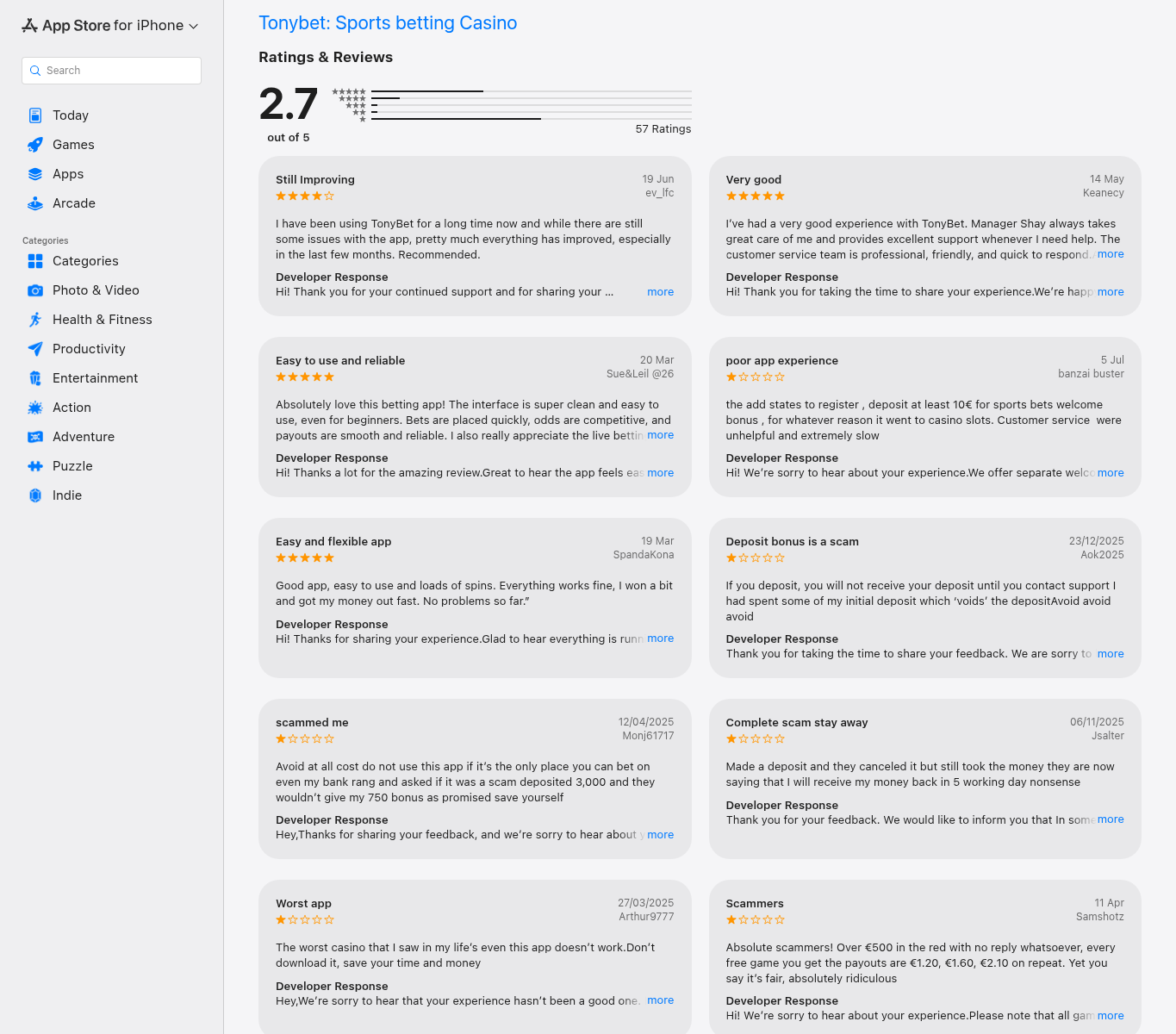
If the journey begins in an app marketplace, record the app name, store listing and the website reached from any account or support link. The packet includes an App Store capture containing user ratings and review statements, but those statements are contextual allegations or opinions rather than verified findings. They cannot establish payment reliability, ownership or complaint outcomes.
| Mobile checkpoint | What to inspect | Reason to pause |
|---|---|---|
| Advert | Destination preview and wording | Pressure to deposit before checking the address |
| Redirect | Each address shown during the transition | Unrelated or misspelt hostname |
| Landing screen | Final hostname: tonybet.com | Different domain or deceptive suffix |
| Account access | Same verified address before credentials are entered | Sign-in form on another hostname |
| Payment screen | Recipient, amount, currency and terms | Unexpected recipient or changed conditions |
Hostname, operator and licence match
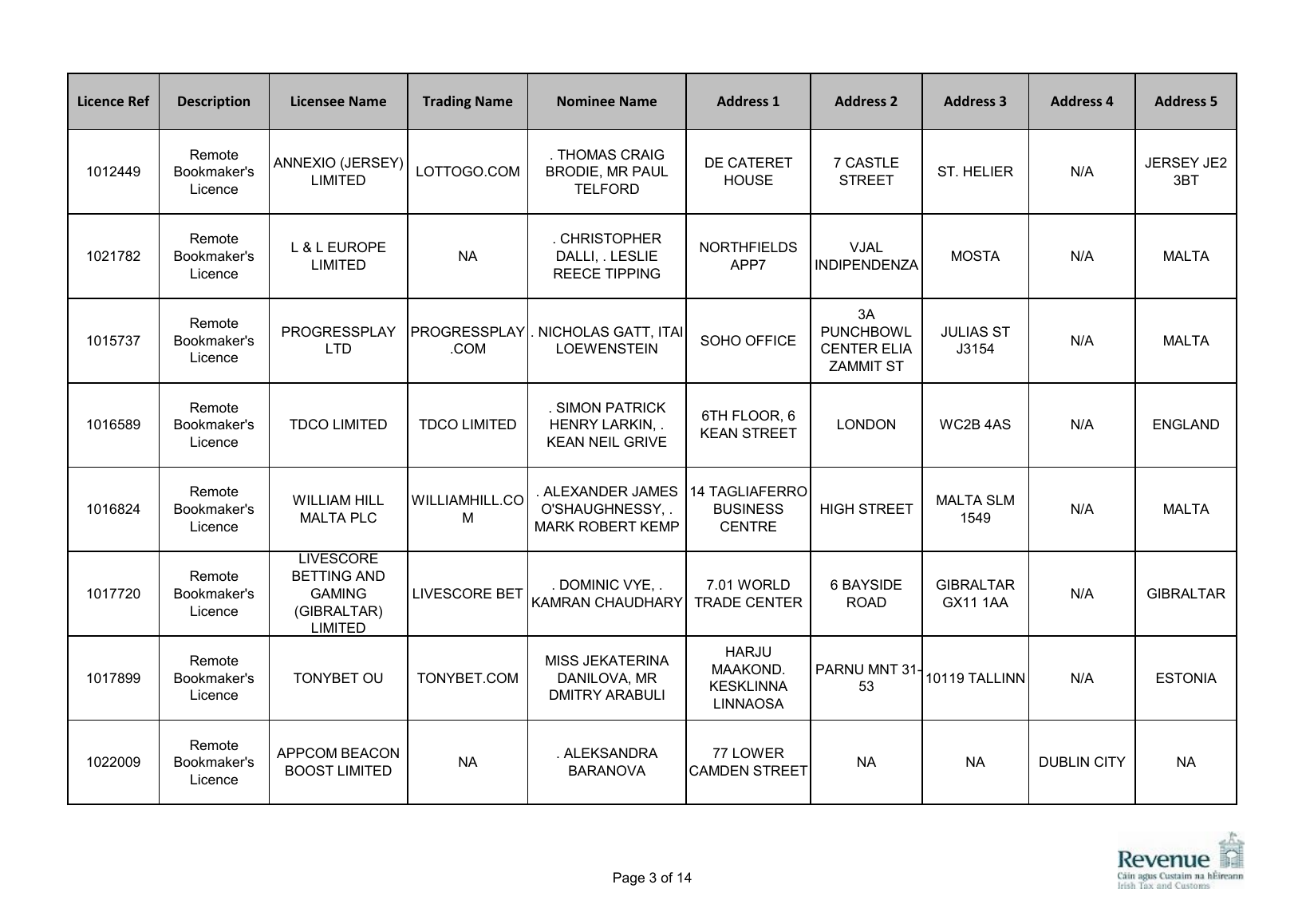
The strongest supplied evidence is the Irish Revenue register dated 30 June 2026. The relevant entry lists TonyBet OÜ with the TonyBet trading name or domain under remote bookmaker reference 1017899. The Revenue register entry was checked on 21 August 2026.
This is a three-part match: the public-facing name, the named legal entity and the Revenue reference appear together in a primary record. It answers an important identity question, but its scope should remain precise. The packet does not state an expiry date, reproduce licence conditions or establish that every address using similar branding belongs to the listed entity. It also does not replace checking the live hostname before registration or payment.
| Identity field | Supported finding | Boundary of the evidence |
|---|---|---|
| Trading name | TonyBet | Does not authenticate lookalike addresses |
| Legal entity | TonyBet OÜ | No additional corporate details were supplied |
| Irish reference | 1017899 | No expiry date was supplied |
| Register date | 30 June 2026 | A later register should be checked when available |
| Verified domain | tonybet.com | Redirects and subdomains still require inspection |
For a repeatable process, use the internal licence-checking guide and compare the exact entity rather than relying on a logo or advert.
Is it legitimate and legal for Irish customers?
The evidence supports a narrower conclusion than a blanket endorsement. A current supplied primary record connects the trading name and TonyBet OÜ with an Irish Revenue remote bookmaker reference. That is material evidence against treating the named service as an unidentified operation. It does not prove that every promotion, mirror, app, social account or payment request using the name is genuine.
The legal framework is also in transition. The GRAI operator portal states that the Gambling Regulatory Authority of Ireland began accepting remote and in-person betting applications in February 2026 and notes the Revenue transition. The Gambling Regulation Act 2024 establishes the statutory framework and the GRAI. Those records explain why a Revenue entry and the developing GRAI system must be read in their dated context.
“Legal” should therefore refer to the documented Irish record for the identified entity, not to an assumption that every product, promotion or customer circumstance has been approved. “Legitimate” should refer to the identity match, not a promise about service quality. The open evidence does not justify calling the service a scam, but it also does not justify a green signal covering payments, withdrawals or support performance.
| Question | Evidence-led answer | Confidence |
|---|---|---|
| Is a named Irish record supplied? | Yes, reference 1017899 in the register dated 30 June 2026 | Primary support |
| Does the entity match? | Yes, the entry names TonyBet OÜ | Primary support |
| Is every similar address genuine? | Not established | Requires live checking |
| Are withdrawals proven reliable? | No withdrawal test was supplied | Unknown |
| Is a scam finding established? | No official adverse or corroborated finding was supplied | Open evidence |
App and browser payment path
The packet does not identify cards, bank transfer, digital wallets, minimum deposits, fees, processing times or currency-conversion rules available to an Irish account. Listing any of those as accepted would be inference. Treat the cashier shown after sign-in as a live offer that needs to be read at the time of use, not as a feature confirmed here.
Before paying, take note of the final hostname, displayed payment method, recipient description, amount, currency, stated fee and any wagering or withdrawal condition attached to the deposit. Check whether the app sends the payment step into a browser and whether that browser remains on the verified domain. If a third-party processor appears, its presence alone neither proves nor disproves legitimacy; the key questions are whether the hand-off was expected and whether the transaction details match what was authorised.
Do not send money after an unsolicited message asks for a manual transfer, cryptocurrency payment, remote-access session or extra “release fee”. None of those routes is supported by the packet. If the cashier details differ from the information shown immediately before authorisation, cancel and preserve the screen. The payment-checking guide provides a neutral checklist for recording the transaction without assuming a successful result.
A sensible first transaction is one whose loss would not create pressure to chase it. Read deposit and withdrawal rules before funding, and retain the confirmation. This is risk control, not evidence that a particular method will be accepted or that a later withdrawal will follow the same route.
Withdrawals, verification and account controls
No funded account test, withdrawal request, settlement timestamp or verified customer file was supplied. There is also no accepted evidence describing when identity verification is requested, which documents are accepted, how long review takes or whether a payment method must be reused for withdrawal. Those points must remain unknown.
Customers should expect that a regulated gambling account may involve identity, age, address, payment-ownership or source-of-funds checks, but the packet does not establish the operator’s exact procedure. Do not upload documents through a link received in an unexpected message. Navigate independently to the verified address, sign in there and compare the request with information inside the account. Redact information only where the service explicitly permits it; an altered document can be rejected.
For any withdrawal, create a dated record containing the requested amount, displayed status and every message received. Distinguish a pending request from a refusal, reversal or completed transfer. A delay is not by itself proof of wrongdoing, while an unexplained request for additional money should trigger caution. Never pay a separate fee merely because a message claims it will unlock winnings.
| Event to record | Useful detail | What the packet proves |
|---|---|---|
| Verification request | Date, channel and requested document | No exact procedure supplied |
| Withdrawal request | Amount, currency and timestamp | No test supplied |
| Status change | Exact wording and time | No processing duration supplied |
| Support contact | Case number and response | No support outcome supplied |
| Final receipt | Net amount and receiving account | No completed withdrawal supplied |
Set personal limits before depositing and use the responsible gambling information if play is becoming difficult to control.
Complaint signals and escalation route
The supplied App Store material displays dated user ratings and review statements about the app. Such material can indicate topics worth checking, but it is not independently verified evidence that a reported event occurred, affected an Irish account or remained unresolved. Ratings can also change and may refer to different app versions. They should not be converted into factual findings about the operator.
A useful complaint starts with a concise chronology: account identifier, relevant transaction, date, amount, expected resolution, actual outcome and requested remedy. Attach only material needed to understand the issue. Keep copies outside the account in case access changes. Ask for a case number and a final written response rather than relying solely on a live-chat summary.
If the response is incomplete, use the complaints guide to organise the record and identify the appropriate escalation route for the issue. Do not describe a complaint as upheld unless a competent dated record says so. For suspected impersonation, preserve the full address and message headers, avoid further payment and consult the scam-warning checklist. Immediate concerns about loss of control over gambling belong with urgent help, not a routine commercial dispute.
Clone checks and mobile acquisition risks
The advert-to-address trail creates a specific impersonation risk because a user may remember the design while overlooking the destination. Clones can imitate colours, promotional language and account forms. The licence record authenticates the listed name and entity in its dated context; it does not authenticate a page merely because that page reproduces reference 1017899.
Type the known domain independently or use a previously verified bookmark. Avoid sign-in links in unsolicited texts, messaging apps or paid social comments. Compare every character in the hostname and watch for inserted hyphens, doubled letters, extra words and misleading endings. A genuine-looking path after the first slash cannot repair a false hostname before it.
Treat requests to move a conversation to a private messaging channel as a warning, particularly when combined with urgency, a promised bonus or a demand for payment outside the cashier. Do not install screen-sharing software or disclose one-time security codes. If credentials were entered on a doubtful address, change the password through the independently reached service and secure any reused email or payment account.
A clone report should contain the suspect address as plain evidence, the date, the route by which it was reached and captures showing the browser bar. Do not revisit a risky address merely to collect more material. The absence of a clone record in the packet is not proof that clones do not exist; it means no specific clone finding was supplied.
Evidence chronology, comparisons and open questions
The chronology matters because Irish regulation is moving from the established Revenue register context towards the GRAI framework. The Gambling Regulation Act 2024 provides the statutory foundation. GRAI states that it began accepting relevant applications in February 2026. The Revenue register used for the entity check is dated 30 June 2026, and all supplied records were checked on 21 August 2026.
The same Revenue register also contains comparison entries for William Hill Malta plc under reference 1016824, LiveScore Betting and Gaming (Gibraltar) Ltd under 1017720, and Logflex MT Ltd under 1020856. These comparisons show why the legal entity may differ from the public trading name. They are not quality rankings and do not imply that the services have identical products or customer outcomes.
| Date | Record or event | Relevance |
|---|---|---|
| 2024 | Gambling Regulation Act 2024 enacted | Establishes the statutory framework and GRAI |
| February 2026 | GRAI began accepting specified betting applications | Marks the stated transition process |
| 30 June 2026 | Revenue remote bookmaker register date | Contains the entity and reference match |
| 21 August 2026 | Supplied records checked | Defines the evidence cut-off |
Open questions remain substantial: licence expiry was not supplied; payment availability and fees are unknown; no withdrawal test exists; verification timing is undocumented; no complaint outcome has been established; and user statements have not been independently verified. These gaps are the reason for the amber signal despite the strong identity record.
Method, verdict and correction path
The assessment separates primary records from user context. Primary records support the legal framework, regulatory transition and Revenue identity match. The App Store capture is retained only as contextual material. No operator claim was supplied as support, and no personal account, deposit or withdrawal experience is asserted.
The verdict is amber on an open-evidence basis. The exact trading name and legal entity have meaningful primary support, so a claim that the named operation is wholly unidentified would conflict with the packet. A green verdict would go too far because practical performance and several account-level conditions remain untested. A red verdict would also go too far because no official adverse record or corroborated documented evidence was supplied.
The process follows the internal editorial methodology: match the exact name, entity, domain and dated reference; classify each record by role; state unknowns; and avoid turning user allegations into findings. Readers should repeat the address and register checks when making a decision because records and interfaces can change after the evidence cut-off.
A correction request should identify the disputed sentence, provide a dated competent record and explain whether it changes the entity, domain, licence, payment evidence or complaint status. Use the contact route for that purpose. A marketing assertion, undated capture or anonymous statement may prompt review, but it cannot by itself replace a primary record.
Frequently asked questions
Is TonyBet licensed for Irish remote betting?
The supplied Revenue register dated 30 June 2026 lists TonyBet OÜ with the TonyBet trading name or domain under remote bookmaker reference 1017899. That supports the identified entity in the dated Irish record, but no licence expiry date was supplied.
Is TonyBet a scam?
No official adverse record or corroborated evidence establishing a scam was supplied. The primary register supports an entity match, while payments, withdrawals, support outcomes and possible impersonation attempts remain separate matters that require their own evidence.
Which address should I check before signing in?
The verified domain supplied is `tonybet.com`. Read the final hostname after every redirect and stop if spelling, suffix or added words differ. A lock symbol, copied logo or familiar design does not authenticate a lookalike address.
Which payment methods and withdrawal times are confirmed?
None are confirmed by the packet. It does not identify available payment methods, fees, limits, currencies, withdrawal processing times or a completed withdrawal test. Check the live cashier and save the terms shown before authorising money.
What do the App Store reviews prove?
They prove only that the captured store page displayed dated user ratings and review statements when checked. Those statements are not independently verified findings and do not establish that a reported event occurred, affected an Irish account or remained unresolved.
How should I make a complaint or submit a correction?
For a complaint, preserve a dated chronology, transaction details, messages, case number and requested remedy, then use the documented complaint route. For a factual correction, identify the disputed statement and provide a dated competent record through the contact route.