
LiveScore Bet Ireland: licence evidence and open questions
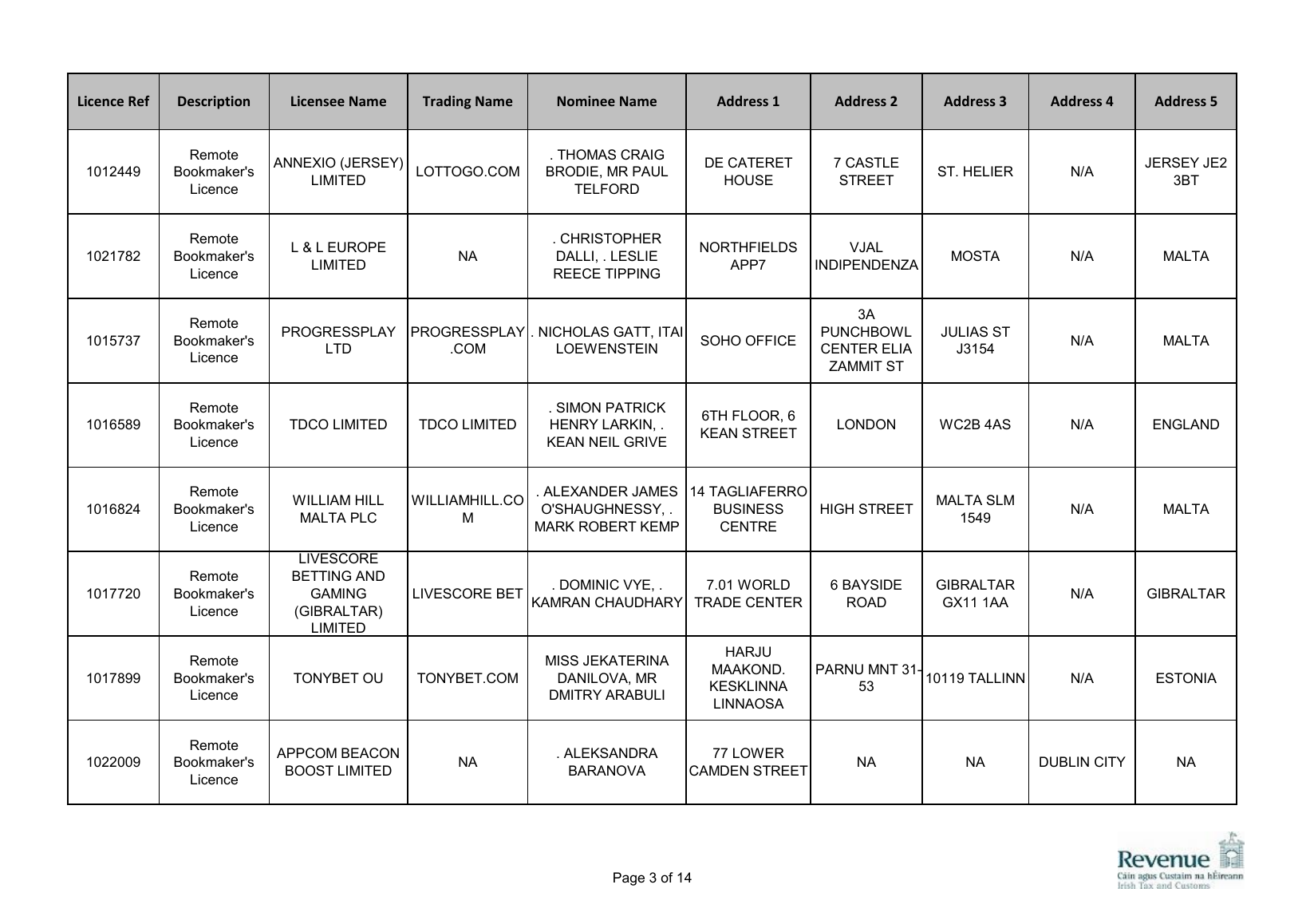
Two signals point in different directions. First, Ireland’s Revenue register dated 30 June 2026 records LiveScore Betting and Gaming (Gibraltar) Ltd under remote bookmaker reference 1017720, with the LiveScore Bet trading name or domain. That is meaningful primary evidence linking the named operator and trading identity within the Irish licensing record.
Second, the accepted evidence does not establish that the register names the exact internet address livescorebet.com. Nor does it document available payment methods, withdrawal performance, identity-check procedures or the handling of any individual complaint. The resulting signal is amber: there is a relevant official entry, but important operational and exact-domain questions remain open.

Verdict at a glance
The available Revenue record supports the existence of a licensed remote-bookmaker entry for the named operator and trading identity. It does not, by itself, prove that every website, advertisement, message or application using similar wording belongs to that business. A user still needs to verify the full internet address and the operator details displayed during registration.
| Question | Evidence-led answer | Confidence |
|---|---|---|
| Is there an Irish Revenue record? | Yes. The register dated 30 June 2026 lists the named operator and trading name or domain under reference 1017720. | High |
| Is livescorebet.com expressly reproduced in the accepted record? | Not established by the supplied evidence. | Open |
| Is the service proved to be a scam? | No official adverse record or corroborated documented evidence was supplied. | Open |
| Are payments and withdrawals independently tested? | No payment or withdrawal test was supplied. | Open |
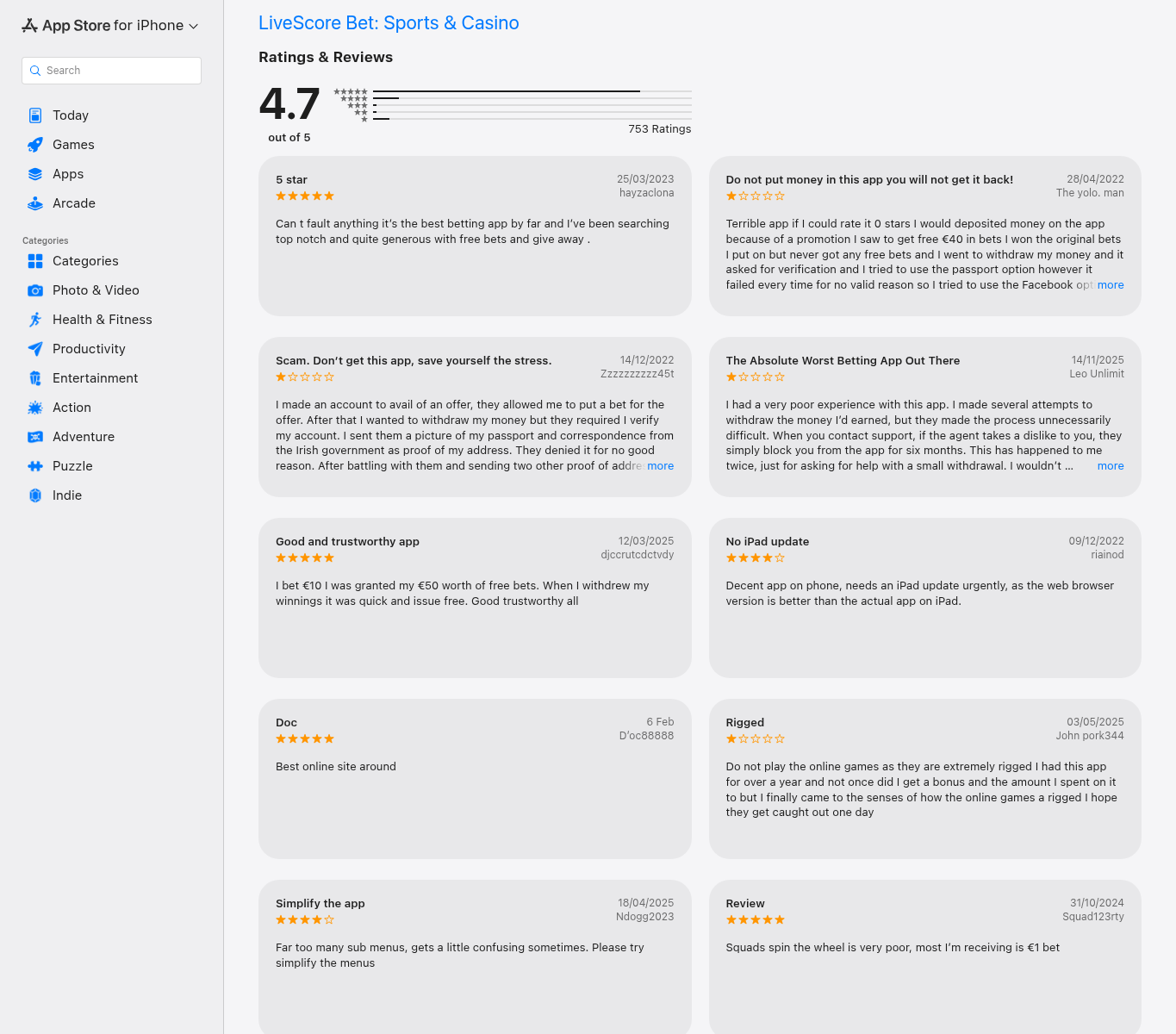
| Is every complaint allegation verified? | No. The captured app-store statements are user context only. | Low |
“Amber” is not a finding of illegality or fraud. It marks a verification gap between a relevant operator-level record and the precise internet address and customer journey a person may encounter. Equally, the Revenue entry is not a guarantee of fast withdrawals, successful account verification or satisfactory support.
What the official records establish
The strongest accepted item is the Revenue register of licensed remote bookmakers dated 30 June 2026. It lists LiveScore Betting and Gaming (Gibraltar) Ltd with the relevant trading name or domain under remote bookmaker reference 1017720. The record was checked on 21 August 2026.
The same register also contains entries for other businesses, including William Hill Malta plc under reference 1016824, Logflex MT Ltd under reference 1020856 and TonyBet OÜ under reference 1017899. Those comparison entries show the register’s structure, but they do not transfer any status, conduct or characteristics from one business to another.
Two broader primary records explain the regulatory setting. The Gambling Regulation Act 2024 establishes the statutory framework and the Gambling Regulatory Authority of Ireland. The GRAI operator portal states that remote and in-person betting applications began to be accepted in February 2026 and notes the transition from Revenue.
These records should be read together rather than collapsed into a stronger claim. The Revenue register supports the specific listed entry. The Act establishes the framework. The portal describes an application and transition process. None of them, in the supplied packet, records a completed GRAI licensing decision for the exact internet address.
Exact domain, operator and licence match
Three identifiers need separate checks: the internet address in the browser, the legal operator named in account documents, and the reference shown in the official register. The expected combination is livescorebet.com, LiveScore Betting and Gaming (Gibraltar) Ltd, and Revenue reference 1017720. Only the latter two are directly supported together by the accepted Revenue fact.
| Identifier | Expected detail | Evidence status |
|---|---|---|
| Internet address | livescorebet.com | Supplied as the target domain, but not expressly confirmed in the accepted register claim |
| Legal operator | LiveScore Betting and Gaming (Gibraltar) Ltd | Supported by the Revenue register |
| Trading identity | LiveScore Bet | Supported as a trading name or domain in the Revenue register |
| Revenue reference | 1017720 | Supported by the register dated 30 June 2026 |
| Licence expiry | No date supplied | Unknown |
Before creating an account, read the address character by character. Check for added words, substituted letters, unexpected hyphens and unfamiliar endings. Then compare the legal name in the terms, account footer or registration disclosure with the official operator name. A familiar visual identity is not enough: copied images and near-identical addresses can create a false match.
The absence of an expiry date in the packet must not be converted into an assumption that the record is perpetual. Status can change after a dated register is issued. For a repeatable process, use the licence-check procedure and record both the document date and the date on which it was checked.
Legal in Ireland, legitimate, or a scam?
The careful answer is bounded. A current-within-the-packet primary record lists the named operator and trading identity in Ireland’s Revenue register. That weighs against describing the recorded business as unlicensed on the supplied facts. However, the packet does not prove that the exact address livescorebet.com appears in the register, and it contains no official finding that every service using the identity is legitimate.
No official adverse record was supplied. There is also no corroborated documented evidence supporting a scam finding. It would therefore be inaccurate to call the operator a scam. It would be equally inaccurate to treat the register as proof that no user can experience a payment delay, verification dispute, account restriction or support problem.
“Legal” can refer to several different questions: whether an operator appears in a tax or licensing register, whether a particular product is authorised, whether the person is eligible to use it, and whether the exact address belongs to the recorded business. The accepted records answer only part of that chain. Users should also consider age, location, account and responsible-gambling restrictions that apply to them; no eligibility rules were supplied here.
The amber assessment reflects open evidence rather than an adverse conclusion. Readers who encounter an imitation address, unexplained request for money or inconsistent operator details can compare the warning signs in the scam-warning guide before sharing information.
Payments, deposits and withdrawals
The packet contains no operator statement or independent test identifying deposit methods, withdrawal methods, processing times, fees, minimum amounts, currency handling or card restrictions. Naming a particular bank card, wallet, transfer service or payment application would be speculation. Availability may also vary by account, device, location and verification status.
| Payment question | What is known | Safe verification step |
|---|---|---|
| Deposit methods | Not supplied | Read the cashier list before funding and save the displayed terms |
| Withdrawal methods | Not supplied | Check whether funds must return by the original route |
| Processing time | Not independently tested | Record the stated timeframe before requesting a withdrawal |
| Fees and limits | Not supplied | Review the amount, fee and currency summary before confirming |
| Withdrawal outcome | No test exists | Keep the request reference and dated account status |
A payment logo displayed during checkout establishes only that an option is presented at that moment; it does not prove universal availability or a particular processing time. Before depositing, note the legal recipient, transaction currency, minimum and maximum figures, any fee disclosure and the route offered for withdrawals. Do not rely on an advertisement or an undated third-party list.
For a withdrawal, retain the confirmation, amount, time, status and any stated deadline. If the status changes, preserve the wording without editing it. The payment-check checklist provides a neutral way to organise those details. No claim about speed or reliability is justified without a documented test tied to a date and account conditions.
Identity checks and account restrictions
No accepted source describes the service’s know-your-customer process. The required documents, review time, acceptable file formats, source-of-funds checks and consequences of incomplete verification are unknown. It cannot be claimed that verification is instant, routine, unusually demanding or responsible for any reported delay.
A prudent user should identify the request inside the authenticated account rather than through an unsolicited message. Check what document is requested, why it is requested, the secure submission route and whether the legal operator name is consistent. Avoid sending identity documents to an address reached through a message link until the internet address has been independently checked.
| Verification point | Packet finding | Record to keep |
|---|---|---|
| Documents required | Unknown | Exact request and date |
| Review timeframe | Unknown | Displayed estimate, if any |
| Secure upload route | Unknown | Account path without exposing credentials |
| Source-of-funds checks | Unknown | Request wording and response receipt |
| Effect on withdrawals | Not established | Withdrawal status and cited account term |
An identity request is not, on its own, evidence of wrongdoing; regulated services may conduct checks. Conversely, a request for sensitive data should not be trusted merely because it uses a familiar name. The decisive checks are the exact address, secure account route, stated operator and consistency with the account’s published terms.
Complaints and user-report context
The App Store capture displays dated user ratings and review statements concerning the application. Those statements are allegations or personal accounts, not independently verified findings. They can identify issues worth testing, but they cannot establish general withdrawal performance, operator intent or the outcome of a particular dispute.
A useful complaint begins with a narrow, provable statement: what happened, when it happened, the amount or account action involved, the term relied upon and the resolution requested. Attach transaction references and relevant correspondence, but remove passwords, full payment-card data and unnecessary identity information.
Send the complaint through the authenticated or formally published support route and request a case number. If the response does not address the disputed point, ask for a final written position and the applicable escalation route. The complaint guide sets out a structured record. Nothing in the packet confirms which external dispute body, if any, has jurisdiction over a specific case, so an escalation destination should not be invented.
Clone and impersonation checks
Impersonation risk is distinct from the conduct of the recorded operator. A clone may reproduce colours, wording or images while changing the internet address, payment recipient or contact details. The strongest first check is therefore textual, not visual.
Compare the complete address with livescorebet.com. Inspect every character and do not assume that a search result, advertisement or message leads to the intended destination. Next, compare the legal operator disclosure with LiveScore Betting and Gaming (Gibraltar) Ltd and the Irish register reference with 1017720. A mismatch does not automatically prove fraud, but it is a reason to stop and verify before paying or uploading documents.
Warning signs include a request to pay a personal account, an unexpected fee said to be required to release winnings, pressure to move the conversation to an unrelated messaging service, or a demand for credentials. No supplied record says that the operator engages in those practices; they are practical checks for possible impersonation.
If a suspected clone is encountered, preserve the full address, time, screenshot and message headers where available. Do not enter credentials merely to gather more evidence. Use the correction and contact route to submit a factual discrepancy without publishing private account data.
Evidence chronology and contradictions
The chronology matters because regulatory arrangements and registers can change. The statutory framework was established by the Gambling Regulation Act 2024. GRAI states that it began accepting remote and in-person betting applications in February 2026 and notes a Revenue transition. Revenue’s supplied register is dated 30 June 2026. All accepted records were checked on 21 August 2026.
| Date | Record | What it supports | What remains open |
|---|---|---|---|
| 2024 | Gambling Regulation Act 2024 | Establishment of the statutory framework and GRAI | A decision for the exact domain |
| February 2026 | GRAI operator-portal statement | Applications began and a Revenue transition is noted | Outcome of any particular application |
| 30 June 2026 | Revenue remote-bookmaker register | Operator, trading identity and reference 1017720 | Exact reproduction of livescorebet.com and expiry |
| 21 August 2026 | Evidence checks | Date on which supplied records were reviewed | Changes after that date |
The apparent contradiction is manageable: an operator can appear in a dated Revenue register while a new authority is accepting applications during a transition. The records do not justify claiming that one cancels the other. They also do not establish the operator’s final position under every future stage of the framework.
Comparators in the Revenue register help confirm how entries are presented, not whether this service is better or worse than William Hill, Novibet or TonyBet. For wider comparisons, the operator-review index should be used without transferring evidence between businesses.
Method, limits and correction route
The assessment gives greatest weight to primary records, uses operator statements only for claims attributable to an operator, and treats user reports as contextual leads. Here, the central operator-level claim rests on Revenue. The legal framework and transition context rest on the Act and GRAI portal. App-store statements are not converted into findings.
No account was opened, deposit made, withdrawal requested, identity document submitted or complaint tested. No licence-expiry date was supplied. Payment methods and support outcomes are unknown. The method also distinguishes a trading-name match from an exact-address match; the former is supported, while the latter remains open under the accepted wording.
The amber signal can change if newer primary evidence expressly links the exact address and operator, or if an official adverse record or corroborated documented evidence emerges. A correction request should identify the disputed sentence, provide a dated primary record where possible, and explain the precise change sought. The evidence methodology explains the hierarchy, while the editorial policy covers corrections.
For readers who have completed the address, operator and terms checks, Continue via reviewed route. This is the sole commercial route included; it does not replace independent verification or responsible-gambling limits.
Frequently asked questions
Is LiveScore Bet licensed in Ireland?
Revenue’s remote-bookmaker register dated 30 June 2026 lists LiveScore Betting and Gaming (Gibraltar) Ltd with the LiveScore Bet trading name or domain under reference 1017720. The accepted evidence does not expressly confirm that livescorebet.com is reproduced in that record, and no licence-expiry date was supplied.
Is livescorebet.com confirmed as the licensed domain?
Not conclusively from the accepted packet. The exact address is the target domain, while the Revenue claim supports the operator and trading name or domain. Check the full address, legal operator disclosure and reference 1017720 together before registering or paying.
Is LiveScore Bet a scam?
No official adverse record or corroborated documented evidence was supplied to support a scam finding. The amber signal reflects open exact-domain and operational evidence, not a finding of fraud. A copied identity or lookalike address must be assessed separately from the recorded operator.
Which payment and withdrawal methods are available?
The accepted sources do not identify any specific payment method, fee, limit or processing time. No deposit or withdrawal test was supplied. Verify the options and conditions displayed inside the correctly identified service before committing funds.
Are App Store complaints proven?
No. The supplied capture contains dated ratings and user review statements, but those statements are contextual allegations or personal accounts. They are not independently verified findings and do not establish general performance or the outcome of an individual dispute.
How should I make a complaint?
Record the date, amount or account action, relevant term, transaction reference, correspondence and requested remedy. Submit it through an authenticated or formally published support route, request a case number and ask for a final written position and applicable escalation route if unresolved.