
Coral Ireland evidence review: identity, licence and withdrawals

An identity-document mismatch can turn an ordinary withdrawal into a difficult evidence problem. A shortened name on a bank card, an old address on a passport or a payment account belonging to somebody else may leave the account holder unable to show that the gambling account, identity record and funding method all belong to the same person. No completed withdrawal test or operator KYC policy was supplied for this assessment, so processing speed and document acceptance cannot be confirmed.
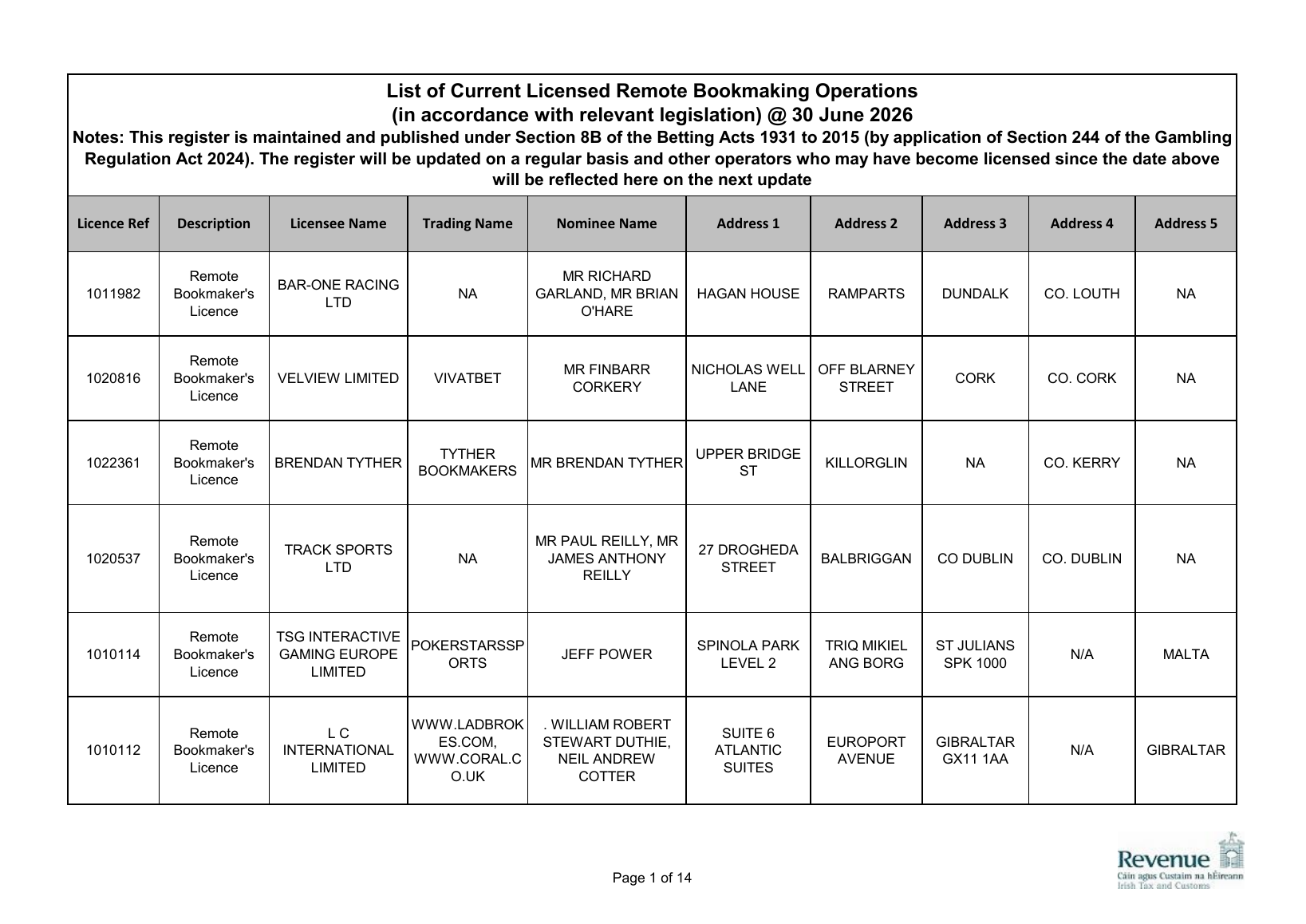
The verified Irish record provides a narrower conclusion. Revenue’s register dated 30 June 2026 lists LC International Ltd with the Coral trading name or domain under remote bookmaker reference 1010112. The supplied packet identifies coral.co.uk as the exact domain. However, the register evidence does not document the full sign-up journey, casino-specific permissions, payment methods, KYC rules or withdrawal performance. The resulting signal is amber: there is current primary evidence connecting the name and company in the Irish register, but important operational questions remain open.
Verdict at a glance
| Question | Evidence-led answer | Confidence |
|---|---|---|
| Is the named business found in an Irish primary record? | Yes. LC International Ltd and the Coral trading name or domain appear under Revenue reference 1010112 in the register dated 30 June 2026. | High for the recorded entry |
| Is coral.co.uk the domain supplied for checking? | Yes, but users should still inspect the address bar before entering credentials or documents. | High for the supplied identity; live routing not tested |
| Is it legal for an Irish customer? | The Revenue entry supports remote-bookmaker registration, while the regulatory system is transitioning to GRAI. It does not settle every product, location or customer-eligibility question. | Moderate |
| Are withdrawals proven fast or reliable? | No. No funded account test, withdrawal test or dated payment record was supplied. | Unknown |
| Is it a scam? | The primary record weighs against treating the named registered business as an anonymous scam, but it cannot authenticate every advert, message, mirror or lookalike domain. | Amber |
Exact domain, company and register match
Three identifiers need to agree before registration or document upload: the address in the browser, the trading name and the legal company in the official record. Here, the supplied domain is coral.co.uk, the trading identity is Coral and the recorded company is LC International Ltd. Revenue reference 1010112 links that company to both the Coral and Ladbrokes trading names or domains in the dated register.
The primary document can be inspected in the Revenue register of licensed remote bookmakers. Its evidential value is specific: it supports the company, trading identity and reference shown on the register date. It should not be stretched into proof that any similarly named domain, social profile, mobile advertisement or payment recipient is genuine.
| Identity element | Verified or supplied value | Practical check |
|---|---|---|
| Exact domain | coral.co.uk | Read the full address from right to left and reject added words, altered spelling or a different ending. |
| Trading identity | Coral | Do not rely on colour, typography or a copied logo as proof. |
| Legal company | LC International Ltd | Compare this name with account, payment and complaint correspondence where displayed. |
| Revenue reference | 1010112 | Check the number and company together, not the number in isolation. |
| Register date | 30 June 2026 | Recheck the current record if acting after a material regulatory change. |
The logo above is an identification aid supplied with the packet, not regulatory evidence. A clone can reproduce visual branding. The stronger check is the combined match between the exact domain, legal entity and dated official entry. See the practical licence-checking process before relying on a badge or marketing claim.
Irish legal position and regulatory transition
The verified records support a careful answer rather than an unconditional “legal everywhere” label. Revenue’s register dated 30 June 2026 records the company under remote bookmaker reference 1010112. Separately, the GRAI operator portal states that remote and in-person betting applications began to be accepted in February 2026 and describes the transition from Revenue.
The Gambling Regulation Act 2024 establishes the statutory framework and the Gambling Regulatory Authority of Ireland. These sources show a changing regulatory environment. They do not establish from the supplied evidence which individual casino games are available, whether every product falls under the same permission, or whether a particular customer is eligible to participate.
A player should therefore distinguish three questions. First, is the company named in a competent Irish record? The supplied evidence says yes. Second, is the visitor on the exact domain associated with the reviewed identity? That must be checked in the browser at the time of use. Third, is the particular activity lawful and available for that person and location? The packet does not answer every product-level or personal-eligibility issue. Responsible participation also requires age, location and account restrictions to be satisfied; no assumption should be made from registration alone.
Account ownership and the KYC mismatch risk
KYC checks are designed to connect an account to a real account holder, but no operator KYC terms, document list or decision record was included. It would therefore be unsafe to promise that a particular passport, driving licence, bank statement or electronic document will be accepted. The useful conclusion is procedural: keep identity, address and payment information consistent from the beginning.
| Mismatch | Why it may matter | Evidence to prepare |
|---|---|---|
| Nickname or shortened first name | It may not match the identity document exactly. | Government-issued identity record and a clear explanation of the variation. |
| Previous residential address | Account details may conflict with current proof of address. | Current dated address evidence and, if requested, evidence linking the old and new addresses. |
| Joint or third-party payment account | Ownership of deposited funds may be unclear. | Proof of account ownership; avoid another person’s payment method. |
| Replaced or expired card | A later withdrawal review may refer to a funding method no longer active. | Retain non-sensitive evidence of replacement or closure from the provider. |
| Blurred, cropped or altered image | Required information may be unreadable or appear manipulated. | A fresh, complete image following the stated upload requirements. |
Before uploading anything, confirm that the browser still shows coral.co.uk, open the document request through the authenticated account rather than an unsolicited message, and disclose only what the stated check requires. Never send a password, one-time security code or complete card security code as identity evidence. If a mismatch is discovered, correct it through the documented support route and keep the confirmation rather than creating a second account.
Deposits and payment-name checks
No supported list of deposit methods, fees, limits or processing times was supplied. The presence of a familiar payment logo must not be assumed, and availability may differ by account or location. The central evidence-desk issue is name alignment: the gambling account holder and the owner of the funding method should not conflict.
Before depositing, record the date, amount, method and transaction reference. Check how the payment appears on the bank or wallet statement, but do not infer the legal operator solely from a shortened statement descriptor. If a payment recipient appears unrelated to LC International Ltd or the expected service, pause and ask for clarification through the authenticated support channel.
The following sequence reduces avoidable disputes: verify the exact domain; read the displayed deposit conditions; use a method in the account holder’s own name; save the successful transaction record; and avoid repeated attempts after an unexplained failure. A declined payment does not prove fraud, while a successful payment does not prove that later withdrawal checks will be straightforward. More preparatory steps are available in the payment checks guide.
Withdrawals: what is known and unknown
There is no funded-account test, requested withdrawal, settlement timestamp, fee record or KYC outcome in the evidence packet. Consequently, no claim can be made about average cash-out speed, weekend handling, reversal practices, withdrawal limits or the reliability of any specific method. User ratings cannot fill that gap because they describe individual allegations or experiences without access to the complete account record.
A sensible withdrawal record should contain the request time, amount, chosen method, displayed status and every subsequent status change. If verification is requested, note exactly which document category was named, when it was submitted and whether the service acknowledged receipt. Redact unnecessary sensitive information when retaining personal copies, but preserve transaction references and the wording of decisions.
| Stage | Record to retain | Warning sign requiring clarification |
|---|---|---|
| Request | Timestamp, amount and confirmation | No confirmation or unexplained change in available balance |
| Verification | Request wording and submission receipt | Request arrives only through an unverified external message |
| Review | Dated status updates | Repeated generic replies that do not identify the outstanding item |
| Completion | Settlement date and matching statement entry | Amount, recipient or method differs without explanation |
| Refusal or cancellation | Full reason and relevant term cited | No specific reason or no route to challenge the decision |
Do not describe a pending payment as stolen funds without a documented finding. Equally, do not accept indefinite delay without asking for a precise status, outstanding requirement and next review date. The evidence packet supports neither a positive nor an adverse withdrawal verdict.
Complaint packet and escalation route
A strong complaint is chronological and narrow. Begin with the account identifier that support asks for, but never publish it in a forum or public review. State the disputed transaction, the expected outcome, what actually happened and the remedy sought. Attach only relevant records and remove passwords, complete card details and security codes.
The packet should include the exact domain used, registration name, transaction references, deposit or withdrawal timestamps, copies of relevant messages, KYC submission acknowledgements and the current status. If an identity mismatch caused the issue, explain the mismatch directly and include evidence connecting the records. Ask for a final response or deadlock position where appropriate rather than sending multiple differently worded complaints.
Use the operator’s authenticated support and formal complaint process first. The supplied evidence does not identify a Coral-specific complaint address, response deadline, alternative dispute body or ombudsman route, so none should be invented. If the internal process fails, consult the complaints guide and verify the competent escalation body against current official information. Regulatory transition matters: the correct destination may depend on the product, event date and licence status.
Clone, phishing and impersonation checks
The primary record supports the named company and trading identity, not every contact claiming to represent them. Treat unsolicited document requests, bonus recovery offers and payment demands as separate authentication problems. A copied logo or screenshot is weak evidence because it can be reproduced without access to the genuine account system.
Check for added words before or after the domain, substituted characters, unusual domain endings and links hidden behind shortened addresses. Navigate independently rather than through a message. If a caller or sender creates urgency, end the interaction and resume through the authenticated account. Never install remote-access software or disclose a one-time security code to “release” a withdrawal.
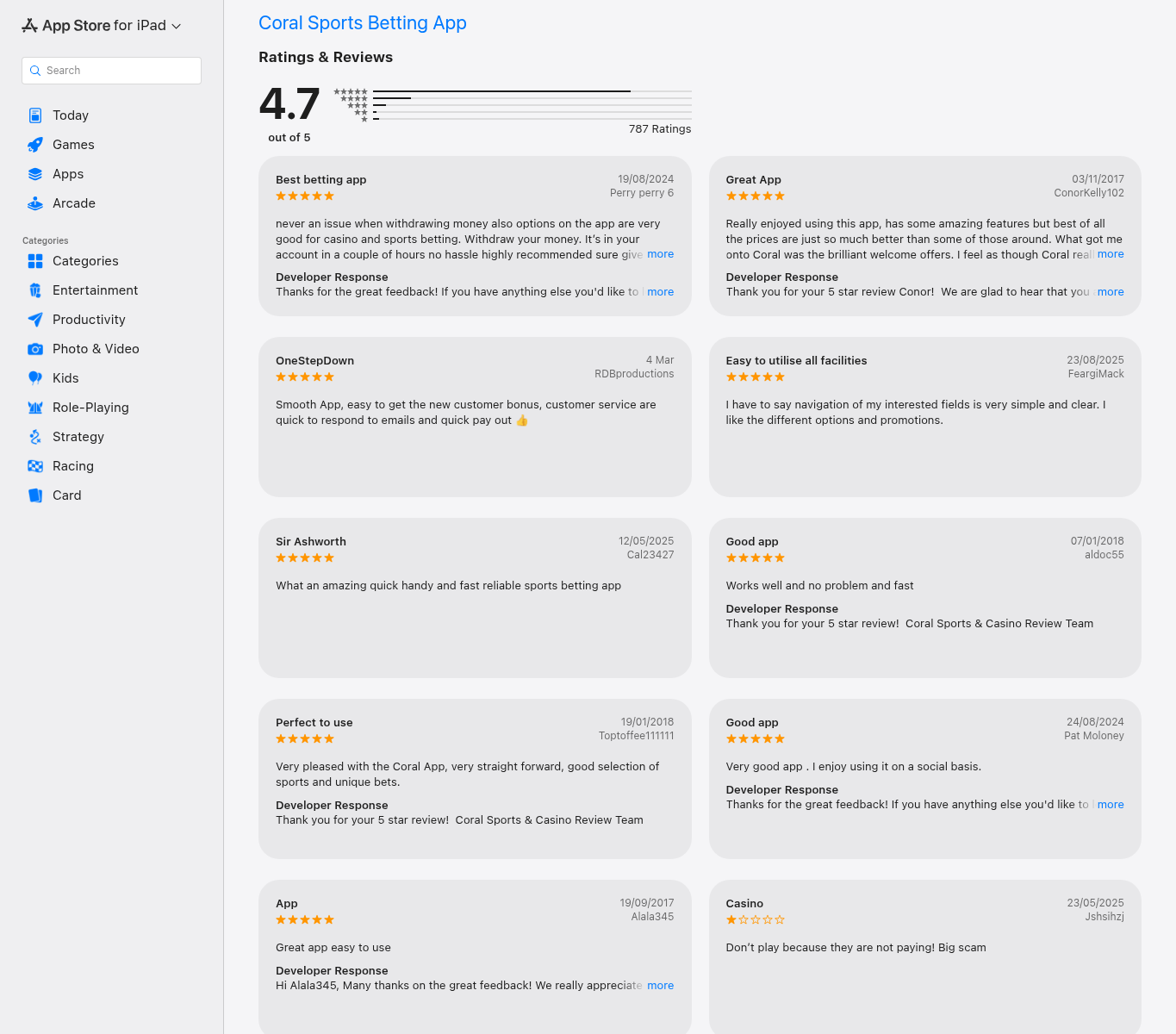
The register capture is evidence of a dated record, not proof that a message is genuine. The App Store capture below is user context only and cannot authenticate a website, resolve an account dispute or establish misconduct.
Further patterns are listed in the scam-warning checklist. If the domain differs from coral.co.uk, do not upload identity documents or send money merely because the design looks familiar.
User reports, privacy and evidence limits
The supplied App Store record shows dated ratings and review statements about the mobile application. Such statements may identify recurring topics worth asking about, but they are not adjudicated facts. Reviewers may omit account history, verification requests, payment ownership or later resolution. Positive ratings are equally unable to prove that another customer will receive the same outcome.
Privacy also limits what can be responsibly assessed. No account file, privacy request, KYC correspondence or operator response was supplied. There is no basis to claim which documents are retained, for how long they are retained, or which internal team can access them. Customers should read the current privacy information presented through the genuine service and use the privacy guide for general handling principles.
Keep complaint evidence secure. Store only what is necessary, redact complete payment-card numbers, and avoid posting identity documents publicly. A regulator entry confirms a recorded relationship; it does not eliminate data-security risk, prove a particular request legitimate or authorise disclosure through an unverified channel.
Evidence chronology and assessment method
The assessment separates official records from user context and open questions. The Gambling Regulation Act 2024 supplies the statutory framework. GRAI states that it began accepting remote and in-person betting applications in February 2026. Revenue’s register dated 30 June 2026 records LC International Ltd with the relevant trading names or domains under reference 1010112. All supplied sources and captures were checked on 21 August 2026.
| Date | Record | What it supports | What it does not prove |
|---|---|---|---|
| 2024 | Gambling Regulation Act 2024 | Statutory framework and establishment of GRAI | The status of every product or individual account |
| February 2026 | GRAI operator-portal statement | Applications began for remote and in-person betting, with a Revenue transition | That a specific application was granted |
| 30 June 2026 | Revenue remote-bookmaker register | LC International Ltd, the trading identity or domain and reference 1010112 | Payment performance, KYC outcome or clone authenticity |
| 21 August 2026 | Evidence check | Date on which the supplied records and user context were reviewed | Events occurring after that date |
The signal remains amber because the current primary record supports the company and trading-name connection, while the exact live journey, product coverage, payment options, KYC practice and withdrawals were not tested. The method does not convert absence of complaints into approval or user allegations into findings. Full assessment principles appear in the methodology.
A correction request should identify the precise statement, provide a dated primary record or complete documentary trail, and explain why it changes the conclusion. Sensitive account evidence should not be sent through a public channel. Use the contact route to request secure handling instructions.
Practical decision checklist
Before proceeding, confirm the full domain, compare the company and Revenue reference, and read the current account terms presented through the authenticated service. Ensure the registration name matches identity evidence and use only a payment method owned by the account holder. Save deposit and withdrawal confirmations from the outset rather than rebuilding the timeline after a problem arises.
The evidence supports recognising a registered business connection, not guaranteeing an individual outcome. Anyone who chooses to continue should set a budget, avoid chasing losses and use the available controls. The responsible-gambling resources provide support options. Where gambling is causing immediate financial or personal harm, use the urgent-help route rather than opening another account.
Frequently asked questions
Is Coral legal in Ireland?
Revenue’s register dated 30 June 2026 lists LC International Ltd with the Coral trading name or domain under remote bookmaker reference 1010112. That supports the recorded remote-bookmaker connection, but it does not determine every product-level permission, customer restriction or circumstance during the transition to GRAI.
Is coral.co.uk the domain checked here?
Yes. coral.co.uk is the exact domain supplied for this assessment. Always inspect the full address before signing in, paying or uploading documents, because an official register entry does not authenticate a lookalike domain or an unsolicited message.
Is the service a scam?
The Revenue entry weighs against describing the named registered business as an anonymous scam. The signal remains amber because no live account, payment or withdrawal test was supplied, and the record cannot prove that every advert, message, app listing or similarly named domain is genuine.
Which KYC documents will be accepted?
The supplied evidence does not contain an operator document list or a completed KYC decision. Use the requirements shown inside the authenticated account, keep the registration name and address consistent with current evidence, and never send passwords, one-time codes or complete card security details.
How long do withdrawals take?
No withdrawal test, processing-time record or method-specific settlement evidence was supplied. Keep the request timestamp, amount, status changes, verification acknowledgements and final statement entry so any delay can be described with dates rather than assumptions.
Where should a complaint be sent?
Use the authenticated operator support and formal internal complaint process first. The packet does not identify a specific complaint address, deadline or external dispute body. If unresolved, verify the competent escalation route from current official information and preserve a concise chronological complaint file.