
Betfred in Ireland: licence evidence and open questions

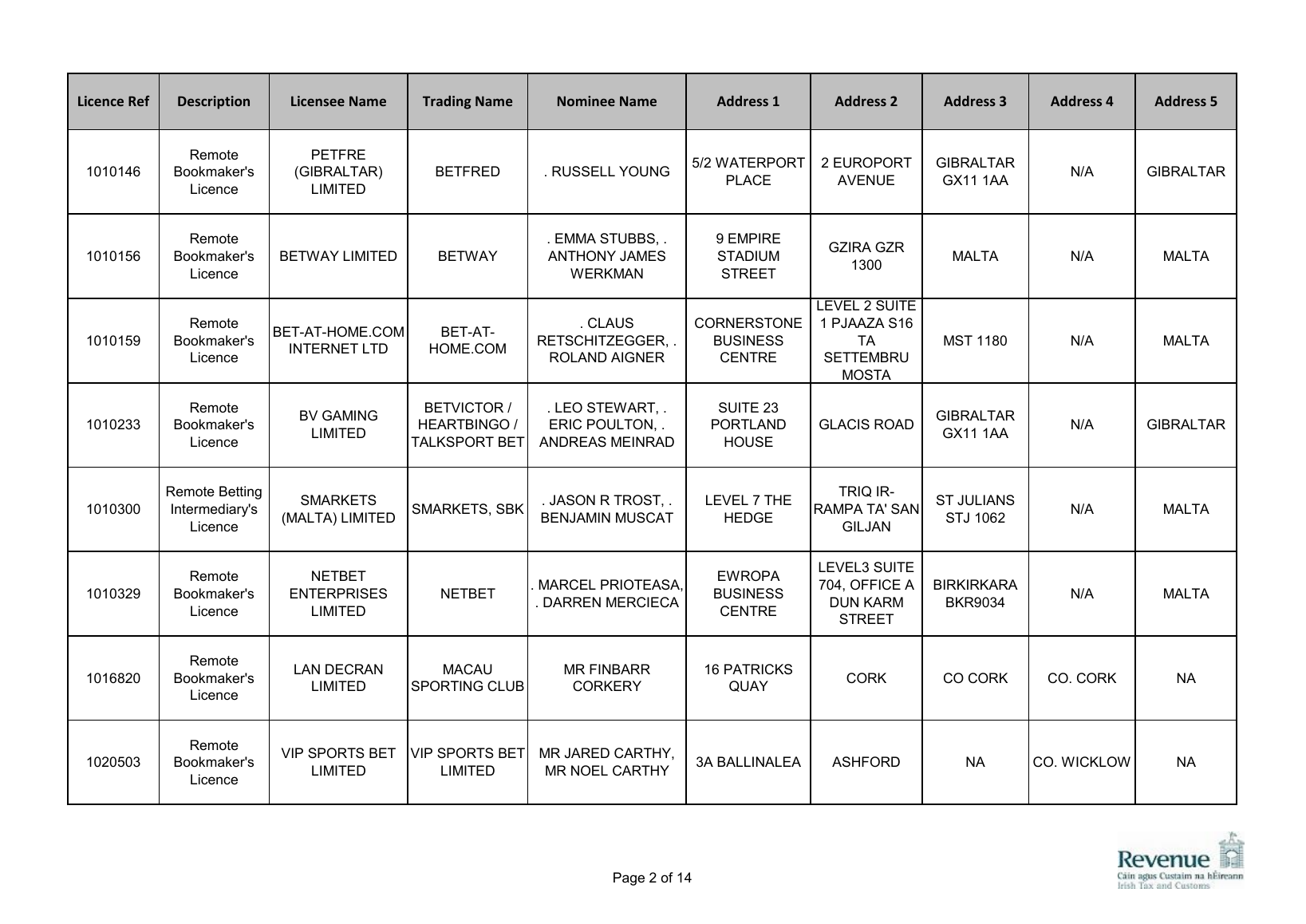
The available primary record supports a specific but limited conclusion: Ireland’s Revenue register dated 30 June 2026 associates Petfre (Gibraltar) Ltd and the Betfred trading name or domain with remote bookmaker reference 1010146. That is meaningful evidence of the named operator’s Irish remote-bookmaking status at the register date. It does not independently prove that every website, message, application or payment request using the name is genuine.
The overall signal is therefore amber rather than green. The operator-to-name record is supported, but the packet does not provide a complete current service test, a verified withdrawal trial, detailed payment terms, identity-check procedures or a direct technical confirmation of every host used during registration and payment. A consumer should verify the exact domain, account terms and transaction recipient before depositing.
| Decision point | Evidence available | Practical conclusion |
|---|---|---|
| Irish remote-bookmaker record | Revenue register dated 30 June 2026 | Petfre (Gibraltar) Ltd is listed with the Betfred name or domain under reference 1010146 |
| Exact website | The supplied domain is betfred.com | Type or inspect the domain carefully; the register entry does not authenticate lookalike addresses |
| Payments and withdrawals | No tested transaction or detailed operator terms were supplied | Limits, fees, processing stages and eligible methods remain unverified |
| Application feedback | A dated App Store capture contains user ratings and statements | Useful as context only, not proof of a systemic problem or successful service |
| Overall assessment | Strong primary identity evidence but open operational questions | Amber: verify before paying and retain records |
What the Irish record establishes
The strongest evidence is the Revenue register of licensed remote bookmakers. Its edition is dated 30 June 2026, and the accepted record links Petfre (Gibraltar) Ltd with the relevant trading name or domain and reference 1010146. The source was checked on 21 August 2026.
This is an entity-level match, not merely a similarity between names. The company name, trading identity and reference appear together in a competent primary record. For an Irish consumer asking whether the service has identifiable local licensing evidence, that record provides a substantive answer. It is more reliable for this narrow question than advertising, search results, application reviews or an unsupported claim on a gambling website.
The finding still has boundaries. A register is a dated record. It does not guarantee account acceptance, uninterrupted access, a particular promotion, a payment method or a withdrawal time. It also cannot make a copied website genuine. The exact address supplied for assessment is betfred.com; additional prefixes, misspellings or unrelated endings need separate scrutiny.
Is it legitimate and legal for Irish customers?
On the supplied evidence, it would be inaccurate to label the named operation a scam. A current accepted primary record identifies Petfre (Gibraltar) Ltd and associates it with remote bookmaker reference 1010146. That weighs against a claim that the named business is wholly anonymous or lacks any Irish remote-bookmaker record.
It would also be too broad to say that every use of the name is safe or that every product is conclusively covered. The evidence specifically concerns the Revenue remote-bookmaker register. The packet does not map each casino game, sports product, promotion, mobile route or payment flow to a separate permission. Nor does it establish whether an individual customer is eligible to register or use a particular offering.
Ireland’s framework is changing. The GRAI operator portal states that the Gambling Regulatory Authority of Ireland began accepting remote and in-person betting applications in February 2026 and refers to the transition from Revenue. Separately, the Gambling Regulation Act 2024 establishes the statutory framework and the GRAI. These records explain why a dated Revenue entry and an ongoing regulatory transition must be read together rather than treated as timeless proof.
| Question | Supported answer | Important limit |
|---|---|---|
| Is there an Irish primary record? | Yes, dated 30 June 2026 | Status can change after the register date |
| Does the record name an operator? | Yes: Petfre (Gibraltar) Ltd | A copied name does not authenticate a different domain |
| Is the service proven scam-free? | No such conclusion is supported | No evidence packet can remove ordinary fraud and impersonation risk |
| Are all casino products confirmed? | Not by the supplied register evidence | Product-level permissions were not provided |
| Is the legal framework static? | No | The GRAI transition is relevant to later checks |
Domain and clone checks before registration
The supplied exact domain is betfred.com. That spelling should be compared character by character before entering a password, identity document or card information. A familiar logo, colour scheme or sponsored message is not enough. Fraudulent copies can reproduce visible design while sending credentials or funds elsewhere.
Start with the address bar rather than a search advert or message link. Confirm that the ending is exactly .com, that no extra word appears before or after the name, and that letters have not been replaced with similar characters. A padlock indicates encrypted transport; it does not prove that the recipient is the licensed operator. If the address changes during registration, identity verification or cashier access, pause and examine the new hostname.
Payment instructions deserve a second check. Do not transfer money because a caller, chat account or social-media contact claims that a deposit, tax, security bond or release fee is needed. The packet contains no evidence supporting off-platform payments or manual transfers to individuals. A request to install remote-access software, reveal a one-time code or move a conversation away from the official account area should be treated as a serious warning.
Use the licence-checking guide to compare the named entity and dated record. The scam warning checklist gives additional steps for suspicious addresses and messages.
| Check | Expected detail | Stop condition |
|---|---|---|
| Domain spelling | betfred.com | Added words, altered letters or an unrelated ending |
| Operator identity | Petfre (Gibraltar) Ltd | A different recipient presented without a clear explanation |
| Irish reference | 1010146 in the dated Revenue record | A claimed reference that cannot be matched |
| Account access | Credentials entered only after checking the address | Password or code requested through email, text or social media |
| Payment route | Terms visible before approval | Personal bank transfer, cryptocurrency demand or release-fee request not supported by verified terms |
Payments, deposits and control points
No supported list of deposit methods, currencies, minimum amounts, maximum amounts, fees or processing times was included. It would therefore be unsafe to promise card acceptance, bank transfer availability, electronic-wallet support or instant crediting. The same applies to claims about whether a method available for deposit can also receive withdrawals.
Before paying, record the method, amount, displayed merchant information and applicable promotion terms. Check whether the cashier identifies any charge, conversion or minimum. If a bonus is involved, save the full conditions before accepting it, especially wagering requirements, qualifying markets, expiry rules, maximum stakes and withdrawal restrictions. None of those details is established by the supplied evidence.
Set a deposit limit before the first transaction rather than after a loss. A small initial amount can reduce exposure, but it is not a substitute for checking the recipient. Avoid repeated deposits made solely to recover previous losses. For practical controls and record keeping, consult payment checks and responsible gambling support.
Continue via reviewed route. Access through that route does not change the amber assessment, guarantee eligibility or establish any payment outcome.
Withdrawals, identity checks and missing service evidence
There is no verified withdrawal test in the packet. No evidence establishes the time from request to approval, the time from approval to receipt, weekend handling, withdrawal limits, fees, cancellation controls or the treatment of a method that cannot receive returned funds. Claims such as “instant withdrawal” or “same-day payment” would therefore be unsupported.
Identity verification is also an open area. A regulated gambling business may request information to verify identity, age, address, payment ownership or source of funds, but the supplied records do not describe this operator’s exact documents, thresholds or review times. Consumers should read the current account terms before depositing and should not send documents through an address or messaging account they have not independently verified.
A delayed withdrawal is not automatically proof of fraud. It can involve identity review, payment-provider processing, account restrictions, promotion conditions or an investigation. Equally, a request for endless new deposits, taxes or release charges should not be normalised without clear contractual and regulatory support. If a withdrawal is delayed, ask for the specific reason, required action, relevant term and complaint reference in writing.
Keep copies of the original deposit, withdrawal request, identity submissions, account messages and any status changes. Redact unnecessary card numbers or identity details when sharing a complaint. Never publish full documents, passwords, security codes or account-recovery answers.
Application feedback and service unknowns
The supplied App Store capture displays dated user ratings and review statements concerning the Betfred mobile application. Those statements are user context, not independently verified findings. They may describe genuine individual experiences, but they do not prove frequency, cause, current conditions or the outcome of a dispute. They also cannot replace the Irish primary record when assessing operator identity.
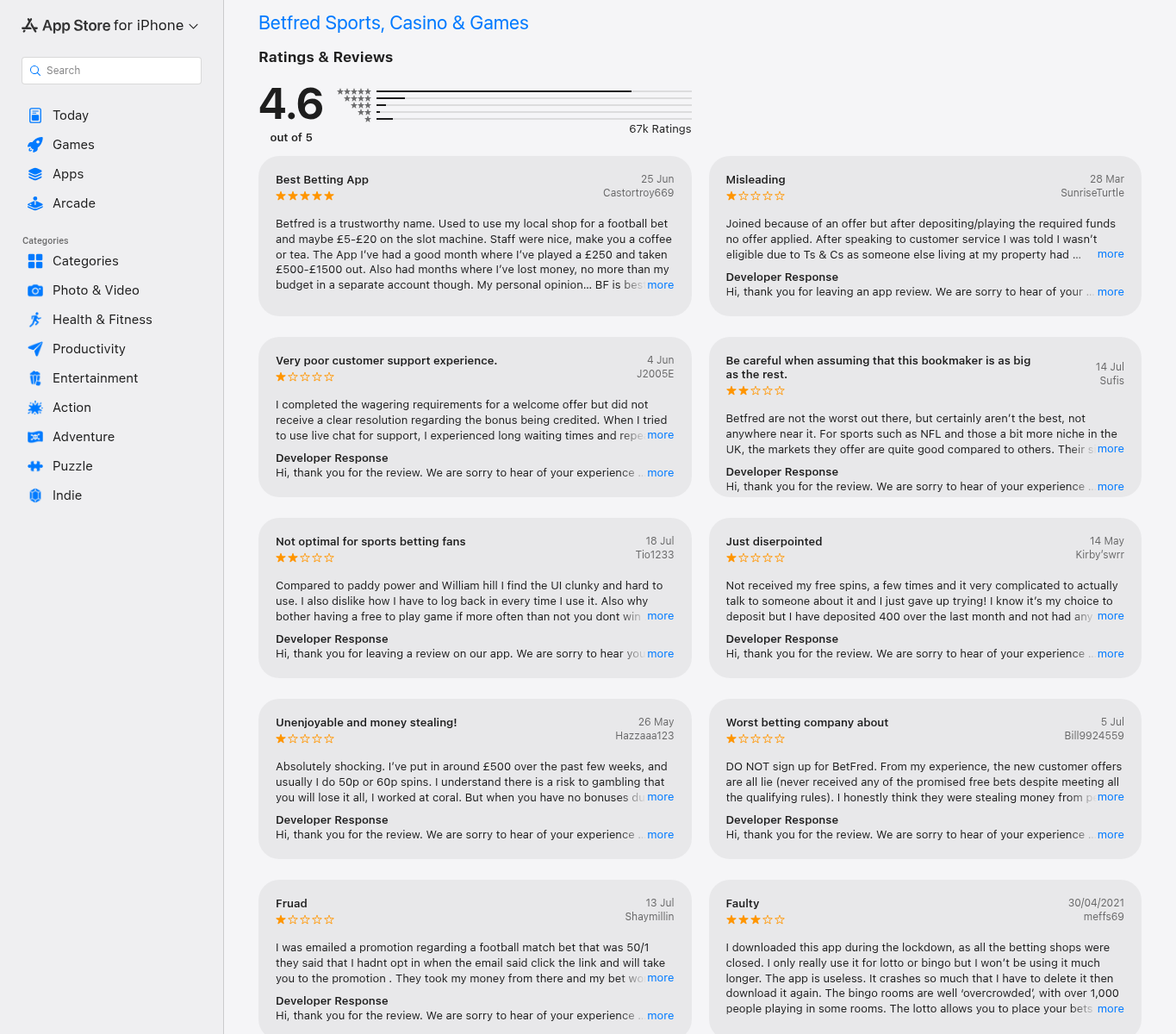
Application-store feedback can still suggest questions worth asking: whether access is stable, whether account messages are clear and whether support responds consistently. It cannot establish that the same event will affect another customer. Ratings may relate to different versions, devices, jurisdictions or dates. The packet supplies no technical test of installation, login, bet placement, game performance or account recovery.
The logo is included for identification, not as licensing evidence.
Complaint route and evidence to retain
Begin with the operator’s formal support or complaint channel visible inside the verified account environment. Describe the issue chronologically and state the requested remedy. Include dates, amounts, transaction identifiers and relevant terms, but send identity material only through a verified secure route. Ask for a complaint reference and a final written response.
If the dispute concerns a payment, first determine whether it is an unauthorised transaction, a processing delay or a disagreement about gambling terms. Contact the payment provider promptly for an unauthorised payment, while avoiding inaccurate chargeback claims for a transaction that was knowingly approved. If account access appears compromised, change the password through the verified domain and secure the associated email account.
The complaints guide explains how to organise a case. Keep a compact evidence file containing the account identifier, verified domain, operator name, deposit record, withdrawal request, relevant terms, correspondence and desired resolution. Do not rely on telephone assurances when a written record can be requested.
The packet does not establish a particular independent dispute body, escalation deadline or guaranteed remedy for this operator. Because the regulatory transition is ongoing, confirm the competent route at the time of escalation rather than assuming that a historic process remains unchanged. Urgent signs of financial harm or loss of control should be addressed through urgent help, not postponed until a commercial dispute is resolved.
Comparisons and alternatives
Two comparison records in the same Revenue register help show what a proper entity-to-trading-name match looks like. BV Gaming Ltd is listed with the BetVictor name or domain under reference 1010233, while Betway Ltd is listed with the Betway name or domain under reference 1010156. These entries do not make either alternative better, faster or safer; they only provide comparable primary-record structure.
| Service | Named entity | Revenue reference | What the comparison proves |
|---|---|---|---|
| Betfred | Petfre (Gibraltar) Ltd | 1010146 | A dated entity and trading-name or domain association |
| BetVictor | BV Gaming Ltd | 1010233 | Comparable register structure, not service quality |
| Betway | Betway Ltd | 1010156 | Comparable register structure, not a recommendation |
Consumers comparing options should focus on current terms, payment transparency, withdrawal controls, identity procedures, complaint access and safer-gambling tools. The BetVictor assessment and Betway assessment can be read as separate evidence files. Do not assume that inclusion in the same register means identical products, account rules or support standards.
Evidence chronology, method and correction path
The core legal framework dates from the Gambling Regulation Act 2024. The GRAI portal states that applications for remote and in-person betting began in February 2026. Revenue’s accepted register is dated 30 June 2026, and all supplied sources were checked on 21 August 2026. This sequence matters: the assessment records a transition period rather than claiming that one dated document settles every later regulatory question.
The method gives greatest weight to primary statutory and regulatory records. Operator identity is accepted only where the company, trading identity or domain and reference can be connected in the source. User comments are retained solely as contextual signals. No personal gambling, payment or withdrawal experience is claimed, and missing service information remains unknown rather than being estimated.
An amber signal reflects that split. The operator match is supported, but current domain authentication, product-level coverage and transaction performance are not fully evidenced. Amber is not an accusation of wrongdoing. It is a direction to verify the exact address, recipient and current terms before exposing funds or documents.
Material corrections can be submitted through contact. A useful correction identifies the disputed statement, provides a dated competent source and explains whether the change concerns the company, reference, domain, regulatory status or service term. The methodology and editorial policy describe the evidence hierarchy and correction approach.
Frequently asked questions
Is Betfred licensed in Ireland?
Revenue’s remote-bookmaker register dated 30 June 2026 lists Petfre (Gibraltar) Ltd with the Betfred trading name or domain under reference 1010146. That supports the named operator’s status at the register date, but later status should be checked against current primary records.
Is Betfred a scam?
The supplied evidence does not support calling the named operation a scam. A primary Irish record identifies the operator and reference. That does not authenticate lookalike websites, unsolicited messages or off-platform payment requests.
Which domain should I check?
The exact domain supplied for assessment is `betfred.com`. Check every character before logging in, uploading documents or paying. Encryption alone does not prove that a website belongs to the licensed entity.
Which payment methods and withdrawal times are confirmed?
None are confirmed by the evidence packet. There is no supported list of methods, limits, fees or processing times and no verified withdrawal test. Read the current cashier terms and retain transaction records.
What should I do if a withdrawal is delayed?
Request the specific reason, required action, relevant term and complaint reference in writing. Keep the withdrawal request, payment records, identity-review messages and account correspondence, then use the formal complaint route if the issue remains unresolved.
How much weight should I give application reviews?
Treat them as user context only. They may identify questions about access or support, but they do not prove a general pattern, establish the cause of an individual event or replace primary licensing evidence.